
Adding speech to a CANTAB battery in Alzheimer's disease/MCI research
After the blood test
In August 2026, the US Food and Drug Administration cleared Roche’s Elecsys pTau217 blood test to aid the assessment of amyloid pathology in adults aged 55 and over with signs, symptoms or complaints of cognitive decline.1 Roche describes it as the first single-biomarker blood test cleared to support both ruling in and ruling out amyloid pathology, using the same cut-offs in primary and specialty care.1 For a field long dependent on PET imaging and lumbar puncture, the clearance considerably widens who can be assessed, and in what setting.
The label is equally explicit about the test’s limits. Its safety and effectiveness have not been established for predicting the development of dementia or for monitoring the effect of treatment.1 Plasma markers are increasingly able to establish who carries Alzheimer’s pathology; they say nothing about how memory, attention or language are changing in that person, which is what most MCI and early-AD studies are designed to measure.
Cognitive assessment therefore remains central, and groups designing a test battery face a practical question about its scope. Episodic memory and language abilities are often impacted early in AD and are therefore a typical focus of cognitive assessment. The case for combining measures of both rests on what each captures that the other does not.
Two windows on the same disease
The pairing of memory and language measures has a long precedent. Blackwell and colleagues followed 43 memory-clinic patients with questionable dementia for 32 months, during which 11 received a diagnosis of probable AD.2 At baseline, those who later converted had made substantially more errors at the six-pattern stage of CANTAB® Paired Associates Learning (PAL) than those who did not (mean 31.0 vs 6.6).2 The best-fitting model in that sample combined PAL with the Graded Naming Test, a pen-and-paper word-finding test. The authors attributed this to anatomy, with PAL dependent on the transentorhinal and hippocampal regions in which Alzheimer’s pathology first appears, and naming on the temporal neocortex.2
Connected speech engages that second set of processes directly. Describing a picture or recounting the previous week draws on lexical retrieval, semantic knowledge, syntactic planning and memory for recent events. From a few minutes of such speech, the Winterlight pipeline derives several hundred acoustic, lexical, semantic and syntactic measures, ranging from pausing and speech rate to word frequency and the semantic relevance of a description to its stimulus.3,4 A meta-analysis of pause and rate measures found that people with AD and, to a lesser degree, MCI showed longer pauses than controls; speech rate also differentiated the groups.5 These pausing and rate differences may reflect the lexical retrieval difficulties, reduced verbal fluency, and executive planning deficits that characterise MCI and AD, consistent with the progressive temporal and frontal lobe changes that underlie these conditions.
Memory as an early marker
Much of the CANTAB evidence in early AD derives from PAL, a measure of visual memory and associative learning. A 2023 study from Perugia examined how CANTAB performance relates to CSF biomarkers in people at the threshold of impairment. Chipi and colleagues assessed 74 consecutive memory-clinic patients with subjective cognitive decline and available CSF results for amyloid (A+) and tau (T+) positivity, using both a traditional pen-and-paper battery and three CANTAB tasks: Pattern Recognition Memory (PRM), PAL and Spatial Working Memory (SWM).6
None of the seven participants who performed normally on both assessments had an AD-like CSF profile (A+/T+), compared with 14 of the 35 (40%) who showed subtle deficits on both (p = 0.03).6 The authors’ principal conclusion was methodological. At this stage, they argue, reliance on a single test risks over- or underestimating decline, and complementary measures should be combined.6 The argument applies equally to the addition of speech assessment.
What speech adds
A potential advantage of speech is sensitivity to change over short intervals. In a six-month study of 50 older adults assessed on a tablet, global coherence (the semantic relevance of a picture description to the picture’s key content) declined significantly faster in participants with MCI or early AD than in those scoring within the normal range on the MoCA.3 Over the same period, neither the MoCA nor the ADAS-Cog changed significantly, nor did any of the standard neuropsychological tests completed by the MCI/AD group.3
In clinical trials, speech can be obtained without a dedicated task. Recordings of Clinical Dementia Rating (CDR) interviews from the Tauriel phase 2 trial allowed Winterlight to analyse the responses of 130 participants with amyloid-confirmed prodromal-to-mild AD to questions about recent experiences from the memory section of the interview.4 A composite of nine acoustic and linguistic features changed over 18 months at a rate comparable to the CDR Sum of Boxes (standardized β 0.29 vs 0.30) and numerically faster than the ADAS-Cog (0.22) and MMSE (−0.23), with similar behaviour in a held-out test set (β 0.26).4 In a subsequent conference poster, the same composite, applied without modification to the placebo arm of a second trial (Lauriet, mild-to-moderate AD), showed a comparable rate of change (β 0.26).7
Speech measures also relate to AD biology. In a further conference poster based on baseline recordings from 429 people with mild-to-moderate AD in a phase 2/3 trial, adding selected speech features to models comprising age, sex and MMSE significantly improved estimates of CSF Aβ42/40, CSF total tau and cortical thickness in AD-related regions.8 The cortical thickness model performed best, with adjusted R2 rising from 0.21 for the base model to 0.35 with speech features added, which the authors suggest may indicate a closer link between speech and current neurodegeneration than between speech and CSF levels of AD pathology.8
CANTAB and speech in one session
Bio-Hermes-002, an ongoing multicentre observational study of adults aged 60–90 with or without memory concerns, examined the two modalities together. In an analysis presented as a poster at AAIC 2026, 353 participants (173 cognitively normal, 180 with MCI) completed CANTAB PAL, the Digit Symbol Substitution Task (DSST) and SWM, together with the Winterlight picture description task (PDT), all administered within the CANTAB app.9
Model (all include age, sex and education) | AUC | Sensitivity | Specificity |
Demographics only | 0.63 | – | – |
+ CANTAB (PAL, DSST, SWM) | 0.72 | 0.73 | 0.63 |
+ speech features | 0.71 | 0.54 | 0.78 |
+ CANTAB and speech | 0.75 | 0.63 | 0.77 |
+ MMSE (clinical reference) | 0.75 | 0.60 | 0.79 |
Adding speech features to the CANTAB model significantly improved model fit (p = 0.002), though the gain in AUC was modest.9 PAL and DSST were the strongest cognitive predictors, and lexical diversity the strongest speech feature.9 The two modalities differed in their operating characteristics: CANTAB tasks were more useful for ruling in (higher sensitivity) and speech for ruling out (higher specificity), while the combined model achieved a more even balance between the two.9 Its AUC matched that of the MMSE reference model (0.75 each); the authors note that MMSE scores contributed to the assignment of MCI status, introducing a degree of circularity into the classification.9
Designing a speech protocol for MCI and AD
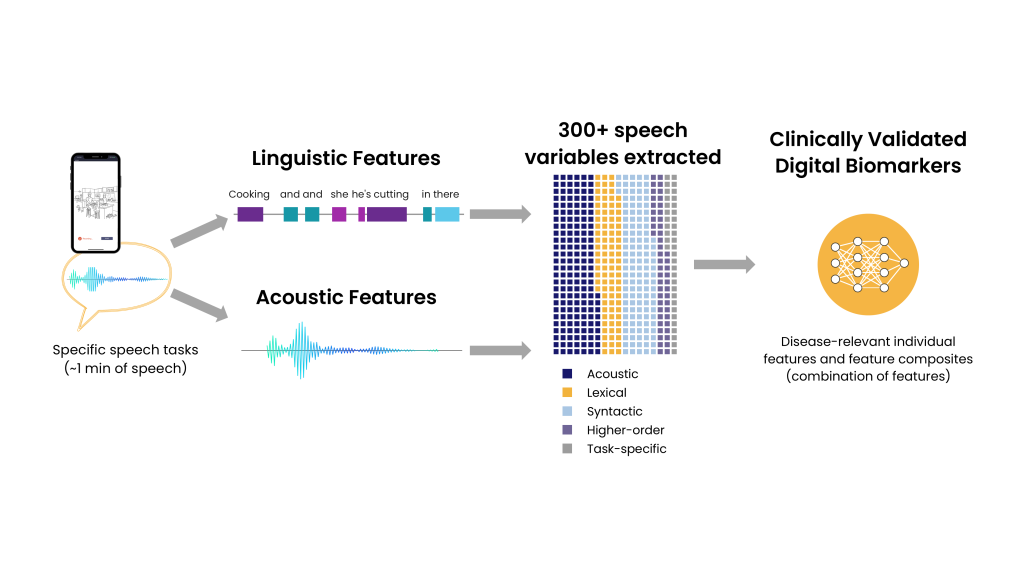
Speech is measured at three levels: the acoustic properties of the voice, the timing of its delivery, and the linguistic structure and content of what is said. In the AD studies discussed here, much of the signal sits at the linguistic level, in global coherence,3 lexical diversity9 and measures of word type, information content and vocabulary,8 and the speech composite score combined six linguistic features with three acoustic ones.7 Linguistic features depend on an accurate transcript, so recording and transcript quality matter as much as the choice of features.
PDT is the task common to most of the AD evidence above.3,8,9,10 Because the scene is fixed, a description can be scored against the information it contains, the basis of information-content measures such as content units and object units. At the same time, the open-ended nature of the task elicits a rich sample of expressive speech and language, capturing variation in syntax, vocabulary and discourse organisation.9
Speech can also be collected remotely and without supervision. In an Amsterdam study of 50 cognitively unimpaired adults using the Winterlight app at home over five days, adherence was 91.6% and only 2.7% of baseline recordings could not be processed.10
Several design lessons follow from the AD evidence:
- Decide whether the question is detection or change. Features selected to separate MCI from normal cognition9 are not the composite built to track 18-month change,4 and each calls for its own validation.
- Prespecify, then test out of sample. The speech composite score was derived in a training set from the Tauriel trial, confirmed in a held-out set and applied without modification to a second trial.4,7
- Average across sessions, and vary the stimulus. Most acoustic features showed relatively low reliability from a single recording, but all reached good test–retest reliability (ICC 0.75 or above) with sufficient averaging, and describing a different picture each session reached that threshold in fewer sessions. For cross-sectional studies in particular, including several task trials and averaging across them is advisable.
- Standardize the recording, including the environment and the distance between speaker and device.10
Where new studies could contribute
The questions these studies leave open translate directly into work that academic groups, with established cohorts and biomarker access, are well placed to run. The Bio-Hermes-002 analysis used each participant’s first assessment,9 so whether a combined CANTAB and speech battery tracks within-person change more sensitively than either alone is a natural next test. The authors of the Tauriel trial speech analysis identify comparison with healthy ageing as a priority,4 which repeated assessment in cognitively healthy older adults would address. The authors of the cortical-thickness and CSF modelling study name blood-based biomarkers as the next step,8 now practical with a plasma pTau217 test cleared in the US.1 Longitudinal work in cognitively unimpaired adults has also been proposed,10 for which prevention cohorts are well suited. The number, spacing and type of speech tasks are open methodological questions in their own right.
A second view
Blood tests will identify Alzheimer’s pathology in more people, and earlier. Whether memory is holding up, or language is beginning to change, remains a question for cognitive assessment, and the current evidence suggests that two complementary modalities answer it more completely than one. For studies already using CANTAB, a few minutes of recorded speech is a modest addition to the protocol.
Speech analysis for academic research
The speech studies above used Winterlight speech analysis, which will soon be available to academic research groups. Picture description, journaling, and paragraph reading and recall are administered through the Connect platform, transcribed by automatic speech recognition and returned as approximately 300 named acoustic, timing and linguistic features, with a feature dictionary defining each one. Because the features are named and interpretable, a study can prespecify a small set, as the Tauriel composite did, rather than reporting the best of several hundred.
If you are considering adding speech to an MCI or AD cohort that already uses CANTAB, or deciding which features to name in a protocol, we are glad to talk it through. Get in touch.
References
- Roche. Roche receives FDA clearance for Elecsys® pTau217, advancing Alzheimer’s disease assessment across primary and specialty care. Press release. August 24, 2026. Accessed October 14, 2026. https://www.roche.com/investors/updates/inv-update-2026-08-24
- Blackwell AD, Sahakian BJ, Vesey R et al. Dement Geriatr Cogn Disord. 2004;17:42–48.
- Robin J, Xu M, Kaufman LD, Simpson W. Front Digit Health. 2021;3:749758.
- Robin J, Xu M, Balagopalan A et al. Alzheimers Dement (Amst). 2023;15:e12445.
- Cohen AS, Divers R, Calamia M et al. J Int Neuropsychol Soc. 2026 Jan;32:24–31.
- Chipi E, Bellomo G, Salvadori N et al. J Prev Alzheimers Dis. 2023;10:523–529.
- Spilka MJ, Xu M, Toth B et al. Robustness and generalizability of a speech-based digital biomarker derived from recordings of the Clinical Dementia Rating (CDR) interview. Poster presented at: Alzheimer’s Association International Conference; 2024; Philadelphia, PA. Abstract: doi:10.1002/alz.094733
- Robin J, Xu M, Spilka M, Cormack F. Speech measures enhance the prediction of Alzheimer’s disease biomarkers. Poster presented at: Clinical Trials on Alzheimer’s Disease; December 1–4, 2025; San Diego, CA.
- De Lillo M, Robin J, Xu M et al. Early identification of mild cognitive impairment using multi-modal digital assessments. Poster presented at: Alzheimer’s Association International Conference; July 12–15, 2026; London, UK.
- van den Berg RL, de Boer C, Zwan MD et al. Alzheimers Res Ther. 2024;16:176.
ENQUIRIES: