Launch of automated quality assurance for clinical trials

News Back to resource centre 24 October 2023 Launch of automated quality assurance for clinical trials Cambridge Cognition (AIM: COG), which develops and markets digital solutions to assess brain health, is pleased to announce the launch today of AQUA, the Company’s automated quality assurance solution for central nervous system (“CNS”) clinical trials that is powered […]

Launch of automated quality assurance for clinical trials Read More »

2023 CANTAB Research Grant winners announced

Cambridge Cognition unveils strategic partnership for Chinese market expansion Cambridge Cognition is pleased to announce an expansion in the Chinese market through a strategic partnership with Luca Healthcare Limited, a category leader in digital screening, treatment and management tools in China. Cambridge Cognition has signed an exclusive licencing agreement with Luca Healthcare

2023 CANTAB Research Grant winners announced Read More »

Cambridge Cognition’s Global Teams Unite for Mental Health Causes! 

News Back to resource centre 24 November 2022 Cambridge Cognition unveils strategic partnership for Chinese market expansion Cambridge Cognition is pleased to announce an expansion in the Chinese market through a strategic partnership with Luca Healthcare Limited, a category leader in digital screening, treatment and management tools in China. Cambridge Cognition has signed an exclusive licencing agreement with Luca Healthcare

Cambridge Cognition’s Global Teams Unite for Mental Health Causes!  Read More »

Why don’t we trust people’s lived-experience of fatigue?

Fatigue is the sort of subjective phenomenological experience that has plagued philosophers and neuroscientists for centuries. For those with lived experience, fatigue can be debilitating, and patients can be left feeling ignored and maligned. Despite over 17 million people across Europe1, reporting symptoms of Long Covid, with fatigue being the most common symptom, there is

Why don’t we trust people’s lived-experience of fatigue? Read More »

Speech based biomarkers for monitoring progressive changes in Alzheimer’s disease

A speech based composite which tracks change in AD over time was recently developed and piloted through a collaboration between Winterlight Labs and Genentech.

Speech is a rich source of clinical information when assessing and monitoring Alzheimer’s Disease. Natural language processing technologies, like those developed by Winterlight Labs, can objectively quantify speech and enable its use as a novel endpoint in drug development.

Speech based biomarkers for monitoring progressive changes in Alzheimer’s disease Read More »

The next generation of treatments for Alzheimer’s Disease in clinical trials

The latest advances in the treatment of Alzheimer’s disease and how Cambridge Cognition are designing and implementing empirically validated and clinically-relevant cognitive tasks to help develop the next generation of Alzheimer’s disease treatments. 

There are presently over 140 drugs being explored as possible treatments for Alzheimer’s Disease (AD) in clinical trials. Of these, nearly 80% are intended to slow the progression of AD. Historically, cholinesterase inhibitor drugs such as galantamine, rivastigmine and donepezil have been approved for treatment of AD. These drugs have been shown to mitigate symptoms of AD, such as memory loss, however they are unable to treat the underlying neurobiological cause of the condition. As such, these drugs do not slow AD progression and are not considered a long-term solution in the battle to end the most common form of neurodegenerative disease.

The next generation of treatments for Alzheimer’s Disease in clinical trials Read More »

Highlights from AAIC 2023

The headline from this year’s AAIC in Amsterdam is undoubtedly the announcement of the results of TRAILBLAZER-ALZ-2, a phase 3 trial of Eli Lilly’s new drug Donanemab with 1,800 participants. Donanemab is an antibody-based drug that works by breaking down already-formed amyloid plaques that build up in Alzheimer’s disease (AD), rather than interfering with their production.

Highlights from AAIC 2023 Read More »

Using a multidisciplinary approach to characterise the neurobiology of addiction

Insights Back to resource centre 6 October 2022 Understanding the effect of ashwagandha root extract on stress, sleep and cognition We caught up with Shefali Thanawala from Nutriventia Ltd who told us how CANTAB™ helped them to investigate the effects of Ashwagandha root extract on memory and focus in healthy, stressed adults. About Nutriventia, Ltd.Nutriventia Limited is the dietary supplements

Using a multidisciplinary approach to characterise the neurobiology of addiction Read More »

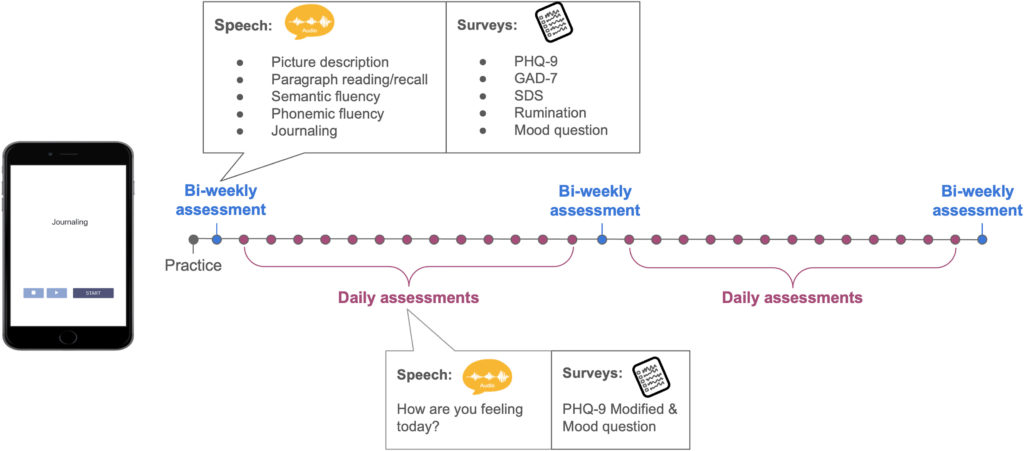
Bi-weekly assessment process

Evaluating the utility of daily speech assessments for monitoring depression symptoms

Publications & posters Back to resource centre 11 January 2023 Evaluating the utility of daily speech assessments for monitoring depression symptoms Depression is a common mental health disorder and a major public health concern, significantly interfering with the lives of those affected. DIGITAL HEALTH recently published a paper on “Evaluating the utility of daily speech assessments for monitoring depression symptoms”

Evaluating the utility of daily speech assessments for monitoring depression symptoms Read More »

Monitoring fluctuations in psychiatric symptoms though analysis of speech

Webinars Back to resource centre 11 January 2023 Monitoring fluctuations in psychiatric symptoms though analysis of speech Several psychiatric disorders including major depression, bipolar disorder and schizophrenia are accompanied by changes in vocal patterns and use of language. These disorders are also characterized by fluctuations in symptomatology that are not well captured using standard clinical assessments. More fine grain monitoring

Monitoring fluctuations in psychiatric symptoms though analysis of speech Read More »

Scroll to Top