
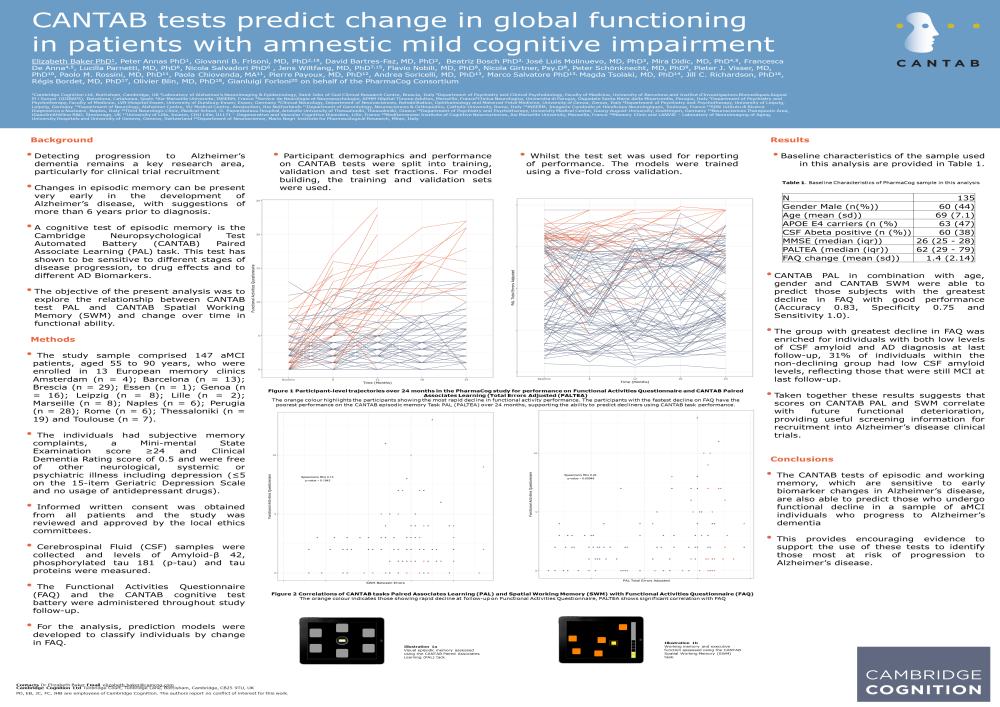
CANTAB tests predict change in global functioning in patients with amnestic mild cognitive impairments

CANTAB tests predict functional decline in patients with amnestic mild cognitive impairment

Insights Back to resource centre 25 October 2018 CANTAB tests predict functional decline in patients with amnestic mild cognitive impairment We presented a novel, predictive model of functional decline at CTAD 2018. The model suggests that CANTAB PAL and SWM provide essential screening information when recruiting patients with amnestic mild cognitive impairment into Alzheimer’s disease clinical trials. BackgroundDetecting the progression


CANTAB tests predict functional decline in patients with amnestic mild cognitive impairment Read More »

Digital Health: Optimizing Clinical Trials with Patient-Centric Technology

Webinars Back to resource centre 11 January 2023 Digital Health: Optimizing Clinical Trials with Patient-Centric Technology Our expert speakers will navigate you through the new field of digital health in psychiatry, to conclude which technologies look to be most promising for optimizing clinical trials, and how to successfully operationalize these digital solutions. Key discussion points How digital health can streamline

Digital Health: Optimizing Clinical Trials with Patient-Centric Technology Read More »

How do acute, subacute and repeated exposures to high altitude affect cognition?

Insights Back to resource centre 16 October 2018 How do acute, subacute and repeated exposures to high altitude affect cognition? We caught up with University of Calgary Postdoctoral Research Fellows, Dr Matiram Pun and Dr Veronica Guadagni, to discuss the role of CANTAB in their recent research paper on how different exposures to high altitude affect cognitive function. Can you

How do acute, subacute and repeated exposures to high altitude affect cognition? Read More »

What is the value of objectively measuring emotional bias?

Insights Back to resource centre 4 October 2018 What is the value of objectively measuring emotional bias? A negative, perceptual bias is associated with the onset and maintenance of mood disorders, and is therefore a therapeutic avenue of interest. Here we will discuss the launch of an objective assessment of emotional bias as a potential biomarker of mood. What is

What is the value of objectively measuring emotional bias? Read More »

Picture of Nathan Cashdollar

How can digital health improve the signal-to-noise ratio in your clinical trials?

Insights Back to resource centre 18 September 2018 How can digital health improve the signal-to-noise ratio in your clinical trials? The contemporary framework for designing clinical trials is to build a comprehensive cognitive profile of the patient population from thorough but infrequent assessments. However, this framework struggles to capture the daily fluctuations in mood and cognition that many individuals with

How can digital health improve the signal-to-noise ratio in your clinical trials? Read More »

Shows N-back test being used on a Apple watch

What is the optimal approach for using digital cognitive biomarkers in clinical trials?

Insights Back to resource centre 14 August 2018 What is the optimal approach for using digital cognitive biomarkers in clinical trials? Digital cognitive biomarkers are typically active or passive: but which approach enhances clinical trial success? Here we will define how active and passive cognitive biomarkers function in clinical trials, to conclude their optimal application. In our last post, we

What is the optimal approach for using digital cognitive biomarkers in clinical trials? Read More »

What are digital cognitive biomarkers and why are they useful?

Insights Back to resource centre 7 August 2018 What are digital cognitive biomarkers and why are they useful? Biomarkers are important for the detection of disease-relevant information to help recruit, stratify and monitor patients, and to evaluate the safety and efficacy of compounds. Here we’ll discuss what digital biomarkers are and how they offer an opportunity to revolutionize research and

What are digital cognitive biomarkers and why are they useful? Read More »

Using affective cognition to enhance precision psychiatry

Insights Back to resource centre 3 July 2018 Using affective cognition to enhance precision psychiatry Precision psychiatry is a promising new approach that seeks to improve outcomes in highly heterogeneous clinical populations. Frontiers in Psychiatry recently published an interesting opinion piece on “Using Affective Cognition to Enhance Precision Psychiatry” 1 by Dr Jack Cotter, Clinical Science Team Lead at Cambridge Cognition, and Dr Jenny Barnett, Chief

Using affective cognition to enhance precision psychiatry Read More »

Why do we need to take mental wellbeing as seriously as physical health at work?

Insights Back to resource centre 20 June 2018 Why do we need to take mental wellbeing as seriously as physical health at work? Physical and mental health are equal partners in the maintenance of wellbeing. However, the value of promoting mental wellbeing is often overlooked in the workplace. An integrated approach to healthThe World Health Organization Constitution Principles describe health as:“A state

Why do we need to take mental wellbeing as seriously as physical health at work? Read More »

Early Alzheimer’s Disease: Finding the Right Patients for Clinical Trials and Beyond

Webinars Back to resource centre 11 January 2023 Early Alzheimer’s Disease: Finding the Right Patients for Clinical Trials and Beyond Despite considerable efforts by biopharmaceutical companies, late-stage trial failures have plagued the drug development process for targeting Alzheimer’s disease. So what’s the problem? Join Dr. Kenton Zavitz and Dr Robert Smith to discuss the issues surrounding the identification of patients for these early

Early Alzheimer’s Disease: Finding the Right Patients for Clinical Trials and Beyond Read More »

Scroll to Top